

How to Train your Employees to Use AI Effectively
Your organization did an AI 101 training. Maybe it was an hour. Someone showed a few impressive demos - a website generated in thirty seconds, a marketing email drafted in ten. Everyone clapped. Someone in the back said "game changer". The facilitator left. People went back to their desks.
And then absolutely nothing changed.
We changed our AI program name. Here’s why.
Marketing Power Circle (MPC) is now AI Power Circle (AIPC).
Same program.
Same audience.
Same Wednesday afternoon energy.
New name.
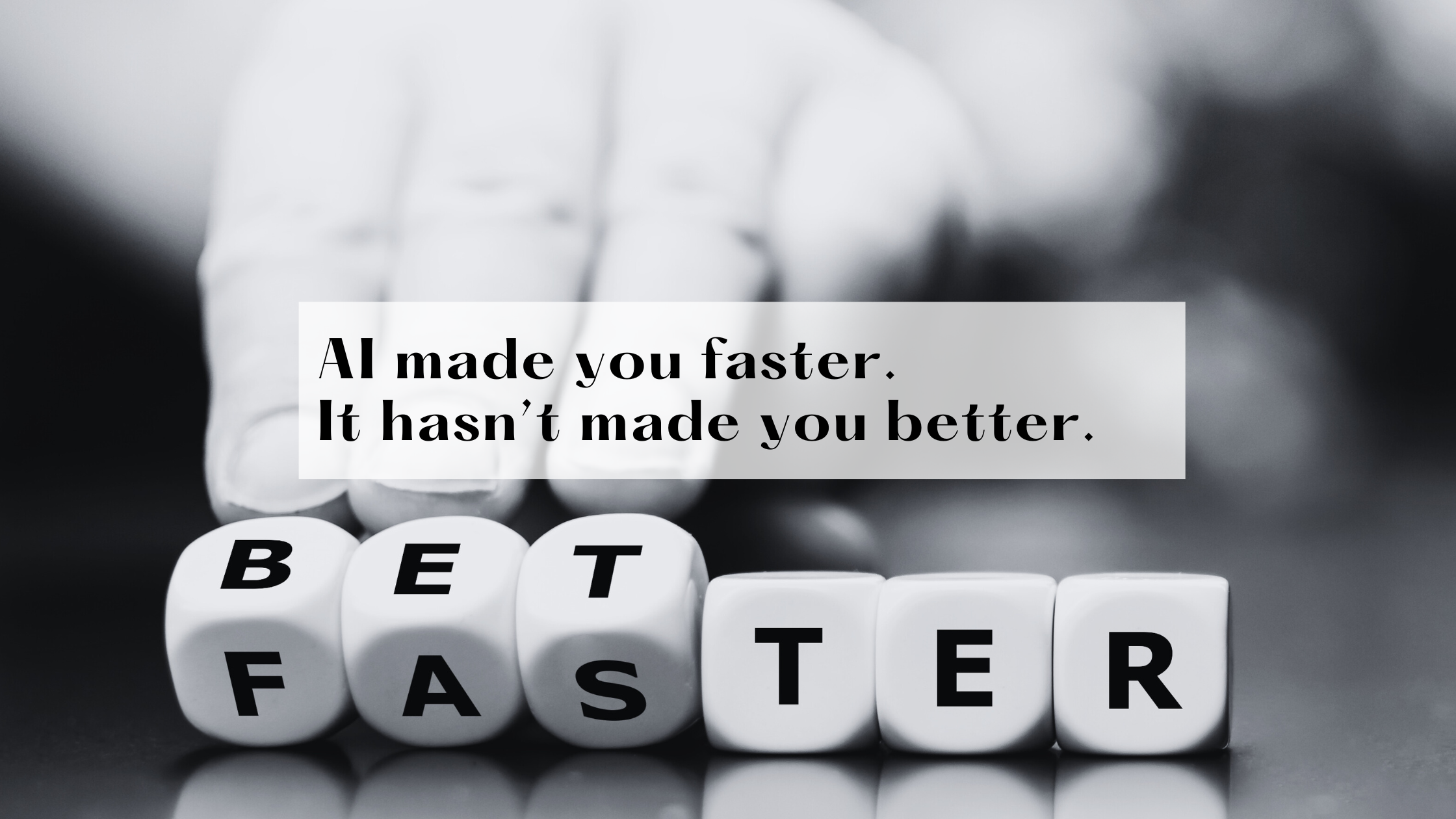
How to Use AI to Improve Work Quality, Not Just Speed
AI makes most people faster. It makes very few people better. The difference comes down to how you use the output. Speed is what happens when you let AI do the work. Quality improvement is what happens when you use AI to do the work, then apply your own judgment to make it sharper than you could have produced alone.
Most organizations are getting the first thing. Almost none are systematically getting the second.
Here's why that happens, and how to fix it.

The New Wage Gap Has a Login Screen
A few years ago, I walked into a boardroom to lead a strategy session and was asked to fix the projector.
Brown woman.
Tech thing broken.
Obviously, I was IT support.
Don’t Let AI Write your Cold Messages Like a Desperate Intern
You know AI could help. You've seen the LinkedIn humblebrag posts - "Just used ChatGPT to land three discovery calls!" You've downloaded the prompt packs. Maybe you've even fed it a request for outreach messages.
And what came back sounded like... a robot cosplaying as you.

Have you heard about the 35K AI jobs that didn't exist last year?
While everyone's busy panicking about job losses, a quiet hiring boom is revealing an uncomfortable truth about how unprepared we really are.
Here's a number that has my attention - 35,000.
That's roughly how many AI policy and governance jobs are currently posted on Indeed alone.
AI won’t Fix your Sales
For many mid-market organizations, scale is the dream!
You get traction, then the work multiplies. More leads. More follow-ups. More handoffs. More “can you just…” requests. And suddenly your sales process becomes less like a pipeline and more like a game of whack-a-mole.

ChatGPT vs. Custom GPTs: Which Should Your Team Use?
For most business tasks, a well-prompted ChatGPT conversation outperforms a poorly designed Custom GPT. For recurring, role-specific workflows, a well-designed Custom GPT outperforms even the best ad-hoc prompting. The question isn't which is better — it's which is right for the task.

Four types of people at the AI cliff. Which are you?
I was not in the famed first 6 million people who tried ChatGPT that first weekend.
I’d seen too many clunky “AI-ish” tools before that overpromised and underwhelmed.
I’m writing my next book in public (with AI)
I have a confession.
I’ve been “writing a book about AI” for over a year… mostly in my head and in a slightly tragic Google Doc.
There are outlines.
There are pillars and frameworks.
There are half-finished drafts and messy notes from conversations with founders.
AI Outreach That Doesn’t Sound Robotic
Founders don’t need more hustle slogans. We need a repeatable way to reach the right people - without sounding like a bot or burning a day on each message.

Your most-asked question - How do I write an Offer One-Pager with AI?
Last week I shared how to build an AI-ready knowledge base so your custom GPTs, agents, and AI tools actually work.
The #1 reply I received?
“Loved the organization - thank you! How do I create an Offer One-Pager?”
How to Organize Your Company Knowledge Base So AI Tools Actually Work
AI tools underperform in most organizations for one reason: the information they need to do useful work is scattered, inconsistent, or inaccessible. The tool isn't the problem. The knowledge structure is.

How to Build an AI Governance Framework That Enables Speed, Not Bureaucracy
Most teams treat AI governance like a brake pedal.
Legalese.
Red tape.
A reason to move slower.
That mindset kills momentum.

How to Go From AI Dabbling to Enterprise-Wide AI Adoption
Most organizations move through four stages on the way from AI dabbling to enterprise-wide adoption: uncoordinated experimentation, governance foundation, structured rollout, and compounding operations. The companies that stall almost always stall at stage two — not because they lack tools or ambition, but because they try to skip governance and go straight to scale.

AI Won’t Be Inclusive by Default - That’s the Leadership Gap
When people talk about AI, the focus often lands on speed, productivity, and cost savings. But here’s the uncomfortable truth - AI won’t be inclusive by default.
Left unchecked, AI systems replicate the same biases and inequities already baked into our data and our workplaces. That’s not just a technical problem - it’s a leadership gap.

AI, Inclusion, and Building the Life you Design
We unpack how AI and DEI (diversity, equity and inclusion) intersect inside organizations. From the reality of companies quietly pulling back on DEI to the urgent need to make AI adoption equitable, Inclusion is not a trend - it’s a value.
The Findability Flywheel: How to Be the Brand AI Can’t Ignore
When people think of getting found on AI (the new world search/SEO) they picture a magic formula - some secret prompt or hack that pushes their brand to the top of ChatGPT, Gemini, or Perplexity results.
In reality, AI discovery works the same way as Google did in its early days: reputation + content + consistency.
This is the Findability Flywheel.

How to get AI to recommend your business
You don’t need another tool.
You need a system that makes AI send you customers.

The Real ROI of AI Literacy is Confidence, Not Just Content
When people talk about AI, they often focus on outputs - faster graphics, smarter copy, automated workflows. That’s real ROI, of course. But it’s not the whole story.
The deeper return on AI literacy isn’t about content at all.
It’s about confidence.