
How to Use AI to Improve Work Quality, Not Just Speed
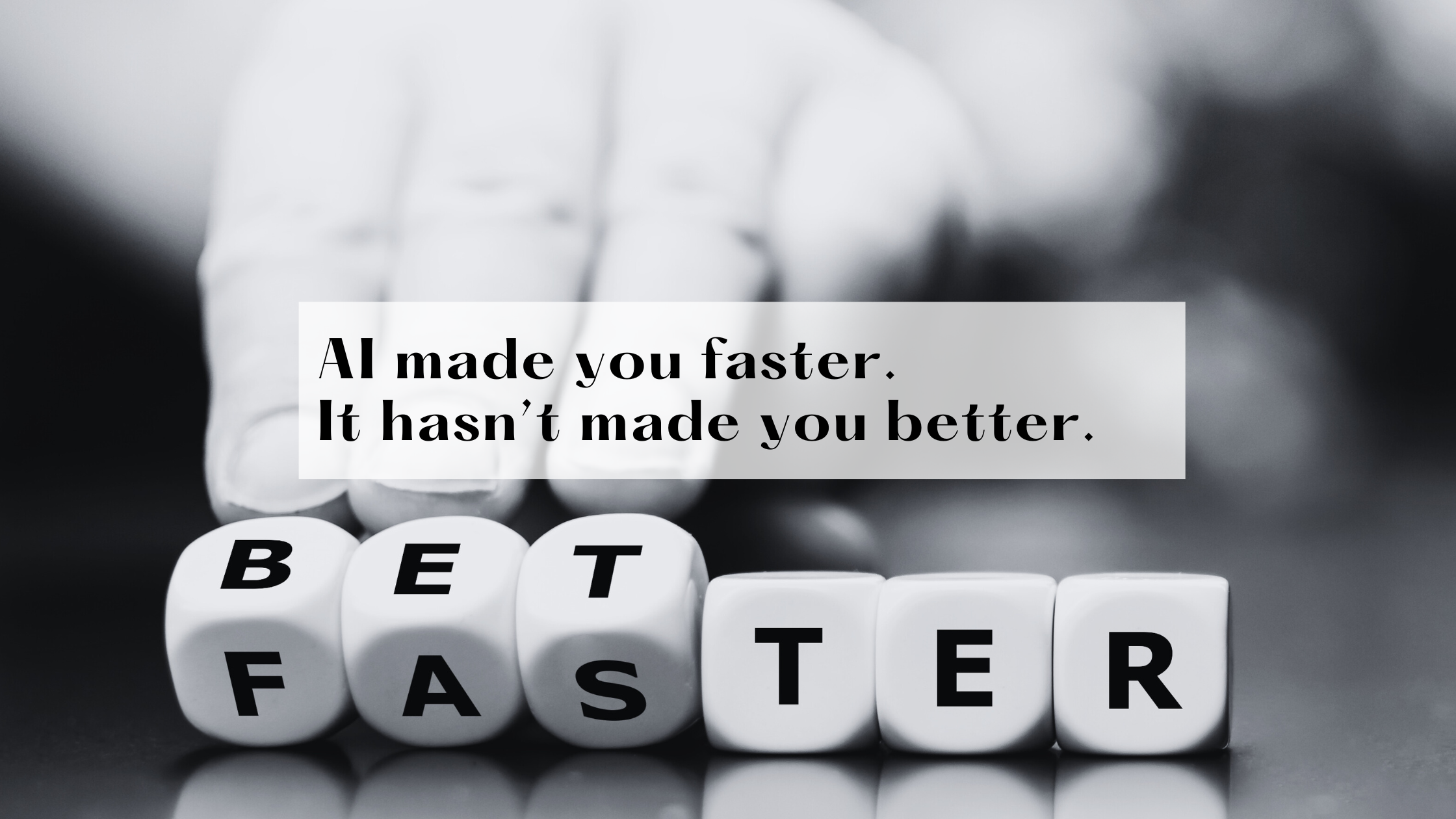
AI makes most people faster. It makes very few people better. The difference comes down to how you use the output. Speed is what happens when you let AI do the work. Quality improvement is what happens when you use AI to do the work, then apply your own judgment to make it sharper than you could have produced alone.
Most organizations are getting the first thing. Almost none are systematically getting the second.
Here's why that happens, and how to fix it.
The Photocopier Problem
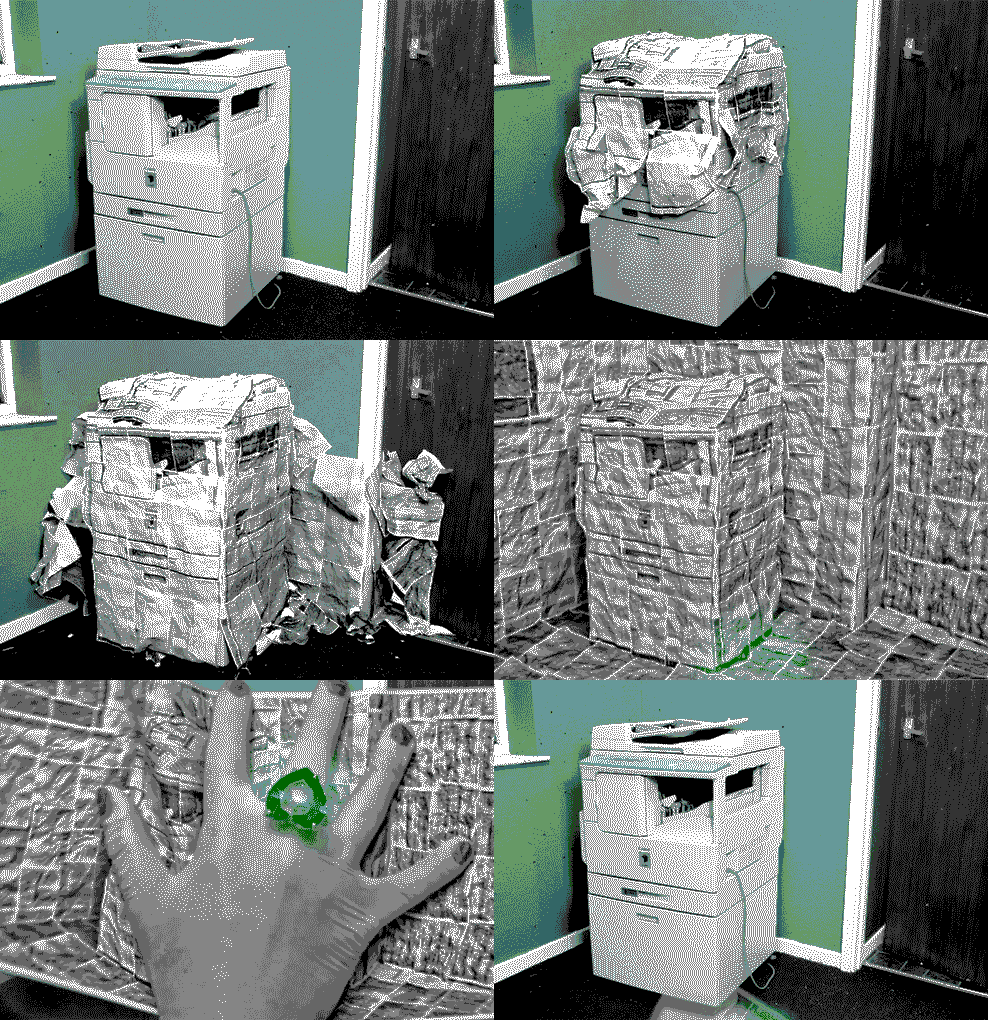
AI is trained on patterns. Patterns are genuinely useful - for structure, for starting points, for getting past the blank page. But patterns are also, by definition, average. They're the composite of everything that already exists.
So when you hand AI a two-line brief and ship whatever comes back, you haven't saved time. You've automated mediocrity. You've turned yourself into a photocopier. A very fast photocopier with excellent grammar and a suspicious fondness for em dashes.
And the thing is - we can all tell.
Suzanne Huber, marketing maven and personal brand strategist, as well as my business bestie whom I cowork in bougie spaces with every chance I get had words to say… I spoke with her on my podcast-to-book sprint from December 2025. If a blog post opens with "In an ever-changing world of..." - you’re looking at first draft garbage. And she's right. That opener is the AI equivalent of a limp handshake. It tells you immediately that nobody was actually home when this was written.
The telltale signs go beyond openers. Unnatural pivots. Corporate hyperbole. The same seven adjectives rotating through every paragraph like a sad carousel. Dr. Jim Kanichirayil, a GTM strategist who builds AI-forward solutions for early-stage founders, sees it constantly in his space. People are looking at AI output as a final product, he told me. And that's a massive mistake.
His benchmark - whatever AI gives you, no matter how well you've trained it, is probably a 60 to 70 percent draft. The questions you should be asking before anything goes out the door is brutally simple. Does this sound like me? Is this something I would actually say?
Most people never ask. They just hit publish.
More Isn't Better. Better Is Better.
That line came from Dr. Jim during a roundtable on my podcast about whether founders should build custom GPTs or just get better at prompting. And it names the thing everyone's tiptoeing around.
The first wave of AI adoption was about volume. How many posts can I publish this week? How many outreach messages can I send? How many proposals can I turn around? The implicit promise was that more output equals more results.
But the results didn't follow. Because volume without voice is just noise. And markets are excellent at tuning out noise.
Andrew Jenkins, a social media strategist who was part of that same conversation, drew a sharp and useful line: automation is helpful. Autopilot is dangerous. Automation means AI handles the drag - the context switching, the first draft, the "where did that info live again" friction. Autopilot means letting raw AI output represent your brand without your eyes on it. That's a reputation risk dressed up as efficiency.
And the market is already punishing it.
The Trust Recession
Kirsten Schmidtke, a sales strategist I had on the podcast, named what's happening downstream of all this generic output: a trust recession. Buyers are more skeptical than they've been in years. More confused. And - here's the line that stuck with me - a confused buyer does not buy.
AI contributed to this. Not because the technology is broken, but because we pointed it at volume instead of value. Every copy-paste LinkedIn DM. Every "just following up!" email that follows up on nothing. Every blog post that sounds like it was written by a well-meaning middle manager who's been soul-dead for forty years. It's all eroding the trust that actual business runs on.
Five years ago, the ickiness around sales was purely a mindset problem. Now there's a new blocker. People on the receiving end of AI-generated outreach are questioning whether a human is even involved. "Are you even a person?" is a real question real buyers are asking. And if your content triggers that question, you've already lost.
The organizations doing this well aren't putting AI first. Kirsten shared a line from one of her clients: "Our priority for 2026 is to be AI forward." Not AI first. AI forward. Intentional about where it enters the process. Clear about where the human stays in the lead.
What you're Actually Outsourcing
Here's where this gets philosophical for a minute. Stay with me. AI doesn't create creativity. It creates options. Lots of them. Fast. And options are genuinely useful - when you have the taste and judgment to choose between them.
But if you're outsourcing the choosing, you're outsourcing the wrong part. You're handing away the messy ideation, the emotional clarity, the lived experience, the risk. You're outsourcing the very things that made your work yours.
Creativity requires two things AI cannot provide - taste and courage.
Taste is what you choose to keep and what you choose to kill. It's what you emphasize. It's the things that are a little weird on purpose. Courage is the willingness to say something that might not land. To take a position. To be specific when being vague would be safer.
AI doesn't do courage. It gives you the statistically most probable next word. That is, by design, the safest possible output. So if your AI-assisted work feels flat, it's probably not because AI is stealing your creativity. It's because you're letting it replace the parts that required bravery in the first place.
The Paintbrush Path
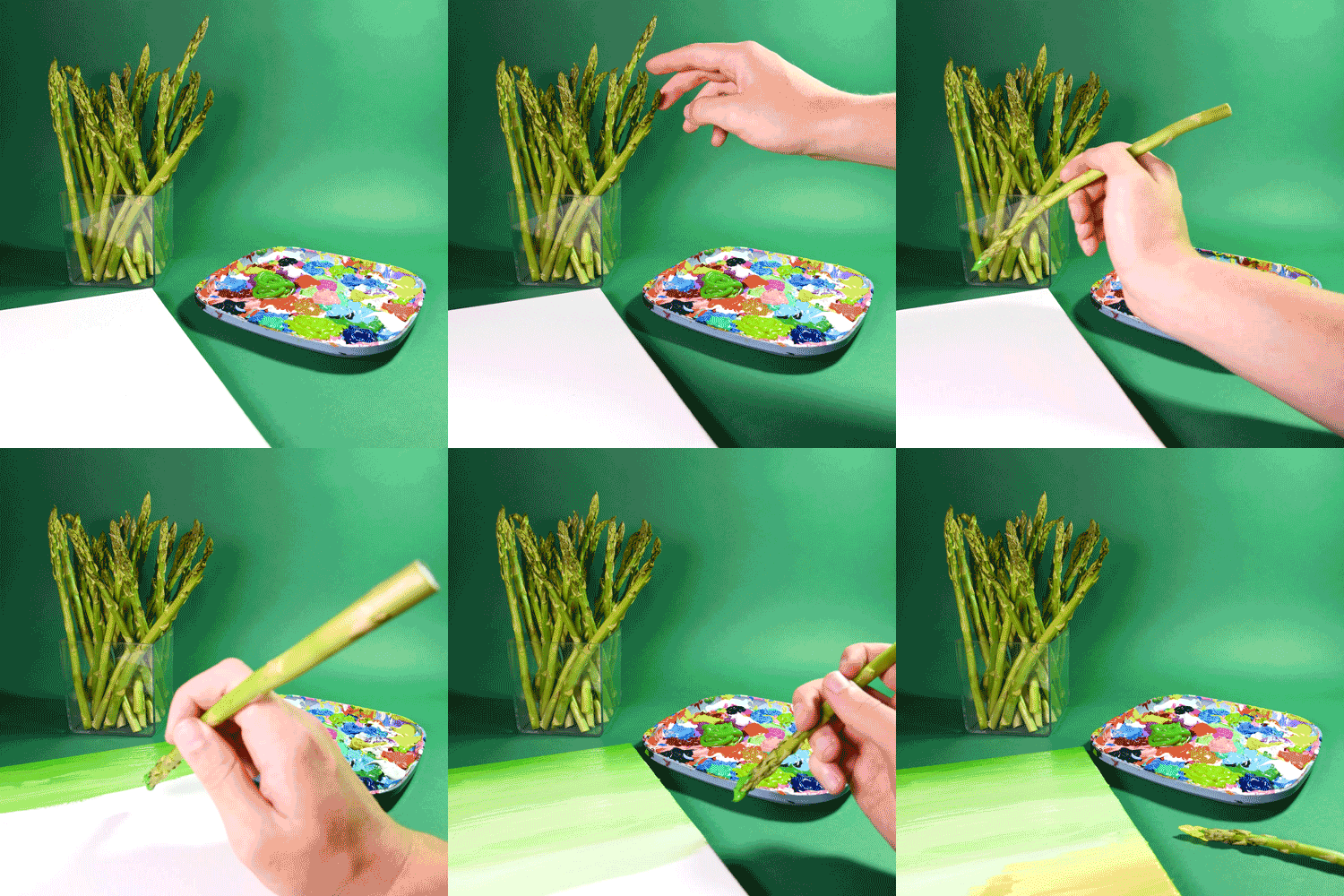
There's another way to use this technology. One that makes you more creative, not less.
Stop asking AI for answers. Start asking it for raw material.
Use it as a sparring partner: "Push back on this idea." "Argue the opposite." "What am I not seeing?"
Use it as a possibility engine: "Give me twenty angles on this." "Give me metaphors." "Give me surprising structures."
Use it to generate constraints - because creativity loves constraints: "Rewrite this as an eight-word active voice headline." "Explain this so a twelve-year-old gets it." "Make this a story with a clear villain."
When you do this, AI becomes a catalyst. It shortens the distance between blank page and something you can legitimately start with. Then the creative act - the actual human work - is shaping that into something with a point of view.
Here's a five-minute exercise you can try right now. Take something you're currently working on - a post, a pitch, a plan, whatever.
Ask your AI three questions
What is the most boring version of this? (Set the floor. Know what you're avoiding.)
What is the boldest version of this? (See the ceiling. Know what's possible.)
What is the truest version of this - for me? (This is where the real work starts.)
Now look at all three.
Pick one thing to keep.
Pick one thing to amplify.
Throw away the rest.
That's creativity in the AI era. Not outsourcing the thinking. Using the machine to think BETTER.
AI doesn't do courage. It doesn't do taste. It doesn't do the thing that makes your work yours instead of everyone else's.
That part's still on you.
The Second Wave
I think we're at a turning point.
The first wave of AI adoption was about speed. How fast can I produce? The second wave - the one that's starting now - is about signal. How clearly can I produce mine?
AI gives you a 60 to 70 percent draft. Your job is to ask the questions and do the chiselling that makes it 100.
Note: Want 10 ready-to-run prompts to uncover audience insight, sharpen your offers, and create smarter marketing content? Get our AI deep research prompt pack.
****
Susan Diaz is the host of AI Literacy for Entrepreneurs and the author of the forthcoming book 'Swan Dive Backwards'. She runs AI Power Circle, an AI implementation mastermind for founder-led businesses ready to stop producing more and start producing effectively. If that's where you are, find Susan Diaz on LinkedIn to see if this is a fit.
