
The Holy Trinity of AI Governance: Why Leadership, HR, and IT Must Align
Shadow AI use rarely starts with employees breaking the rules. It starts with leadership, HR, and IT sending different signals, or no signal at all. Drawing on a conversation with AI researcher James Hutson, this post breaks down the "Holy Trinity" of AI governance and why alignment across all three functions, not just a written policy, is what determines whether employees actually trust it.
What Is an AI Strategy Consultant, and Do You Need One?
What does an AI strategy consultant actually do, and how is the role different from tool training or implementation? This guide breaks down the four things a real AI strategy engagement covers, the signals that tell you whether you need one now, and the questions to ask before hiring one.
Why AI Governance Fails in Schools: The Three-Layer Problem Worth Solving
Most universities have an AI policy but no real AI governance, and that gap is why enforcement (detection tools, penalties, hidden assignment traps) has become the default. Drawing on a conversation with behavioral scientist and professor Eugene Chan, this post breaks down the three governance layers every educational institution actually has, and why teaching students to review AI output beats banning it.

Best AI Consulting Firms for Mid-Market Companies (2026)
Most "best AI consulting firms" lists are published by a firm on the list, ranking itself first. This is a disclosed exception: an honest framework for evaluating any AI consultancy on five specific questions, plus where NorthLight AI genuinely fits and where it doesn't, for mid-market companies between $100M and $1B.
Your AI Bot Just Made a Promise Your Company Can't Keep. Here's Who's on the Hook.
When Air Canada's chatbot promised a customer a bereavement fare refund the airline didn't intend to honor, a tribunal ruled the airline was responsible anyway. This post breaks down what that ruling means for any company deploying AI in customer-facing roles, and where the line between AI and human judgment actually needs to sit.

What Is AI Consulting? A 2026 Guide for Mid-Market Companies
What does AI consulting actually involve, and what should it cost a mid-market company? This guide breaks down the four real components of AI consulting, what you're actually paying for, how to tell if you need it, and the questions to ask before hiring a firm.

Is Your AI Adoption FOMO-Led? How to Tell, and What to Do Instead
Most companies that say "we need AI" can't finish the sentence with a specific outcome, and that's the tell that adoption is FOMO-led, not strategic. Drawing on a conversation with AI consultant David Cohen, this post explains why access to AI doesn't replace the need for a real problem to solve, and the three questions that separate a genuine AI strategy from market pressure.
Your Employees Think AI Is Studying Them to Replace Them. Here's What Our Research Found.
Original research from NorthLight AI found that employees widely believe their AI tool use is being tracked to justify their own replacement. Drawing on that research and a conversation with change management expert Grace Gravestock, this post explains why silence from leadership makes the fear worse, and what to say instead.
Why AI Adoption Fails: The Individual Choice Problem Worth Solving
Most AI adoption fails for the same reason every major technology rollout has failed for decades: people change by individual choice, not by mandate. Drawing on a conversation with 20-year change management veteran Grace Gravestock, this post breaks down the three-step psychology behind real AI adoption and why training alone doesn't fix a stalled rollout.

What Is Responsible AI, and How Do I Implement It in My Company?
Responsible AI is the practice of using AI in a way you'd be comfortable defending in public, to a regulator, or to the employee whose work it affects. That's the whole test. Not a 40-page ethics framework. Not a checklist borrowed from a Big Four slide deck. A standard simple enough that your team can apply it in the moment, not just cite it after something goes wrong.
How to Create an Enterprise AI Roadmap From Scratch
An enterprise AI roadmap that starts with a tool list is a shopping cart, not a roadmap. This post explains the four phases that actually work: baseline audit, governance built in parallel, targeted rollout by function, and a measurement cycle that returns to the audit every six months.

How to Write a One-Page AI Policy for Your Organization
Most AI policies are 14 pages long and live in a shared drive nobody visits. A one-page AI policy answers three questions every employee needs: what data can go into AI tools, how to review output before it leaves the building, and who gets access to what. This post explains exactly what to include and how to write one.
The Biggest Mistakes Companies Make When Rolling Out AI
The biggest AI rollout mistakes aren't technical — they're sequencing errors. Companies buy before they audit, train once and call it done, measure the wrong things, and scope AI as a project instead of an operating model. This post covers the seven mistakes that kill mid-market AI programs and what to do instead.
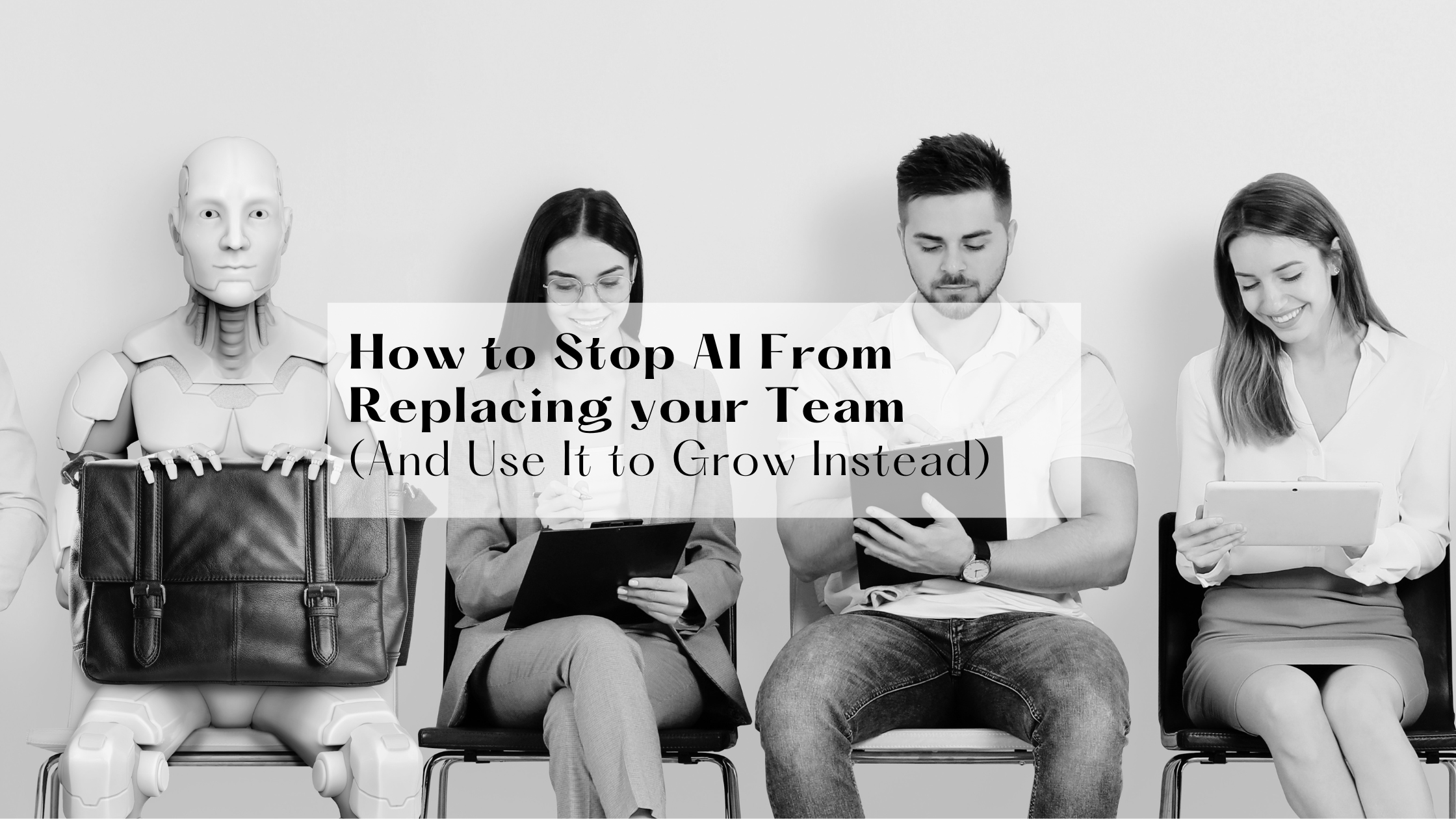
How to Stop AI From Replacing your Team (And Use It to Grow Instead)
The real risk of AI in mid-market companies isn't job replacement — it's bad adoption. When AI is introduced without a clear intent and a named plan for the capacity it creates, teams resist, disengage, and go back to their old workflows. This post explains the three decisions that determine whether AI grows your team or threatens it.
What Is the Difference Between AI Governance and AI Compliance?
AI governance is the internal operating system your organization builds for AI decisions. AI compliance is the set of external rules you're required to follow. Confusing the two is one of the most common reasons mid-market AI programs stall. This post explains the difference, where they overlap, and who should own each.
What Is the AI Flywheel? A Framework for Sustained AI Transformation
The AI Flywheel is a four-stage cycle - Audit, Training, Personalized Tools, and ROI measurement - that builds organizational AI capability over time rather than delivering a one-time lift. This post explains how the framework works, why mid-market companies need it, and how to start the first turn.
How to Prove AI ROI to Your Leadership Team (Before They Cut the Budget)
“We saved 200 hours" doesn't survive a CFO meeting. This post explains why time saved falls flat as an AI ROI metric and introduces the five-metric stack that does: Quality Lift, Risk Reduction, Speed to Opportunity, Decision Velocity, and Learning Velocity — plus how to build a three-layer dashboard that turns AI into an investment conversation.

How to Choose an AI Strategy Consultant for a Mid-Market Company
The right AI strategy consultant for a $100M-$1B company is one that has worked inside organizations with your actual constraints: a real management layer, limited internal AI expertise, and no dedicated transformation budget. Most of the firms that show up in "best AI consultants" lists are built for enterprise clients. Their frameworks, timelines, and pricing reflect that. For mid-market companies, that's usually the wrong fit.
What AI Transformation Actually Looks Like for a $100M-$1B Company
For a company between $100M and $1B in revenue, AI transformation is a series of operational decisions - about governance, training, tooling, and measurement - made in a specific order, repeated in cycles, and owned by leadership rather than IT. It looks less like a software rollout and more like building a new organizational muscle.
What Is an AI Audit? (And Does Your Company Need One?)
An AI audit is a structured assessment of how your organization is currently using AI: what tools are deployed, how employees are actually using them, where the gaps are, and what's working versus what's theatre. It's less of a compliance exercise and more of a diagnostic. And most companies that think they don't need one are the ones who need it most.