
What Is the Difference Between AI Governance and AI Compliance?
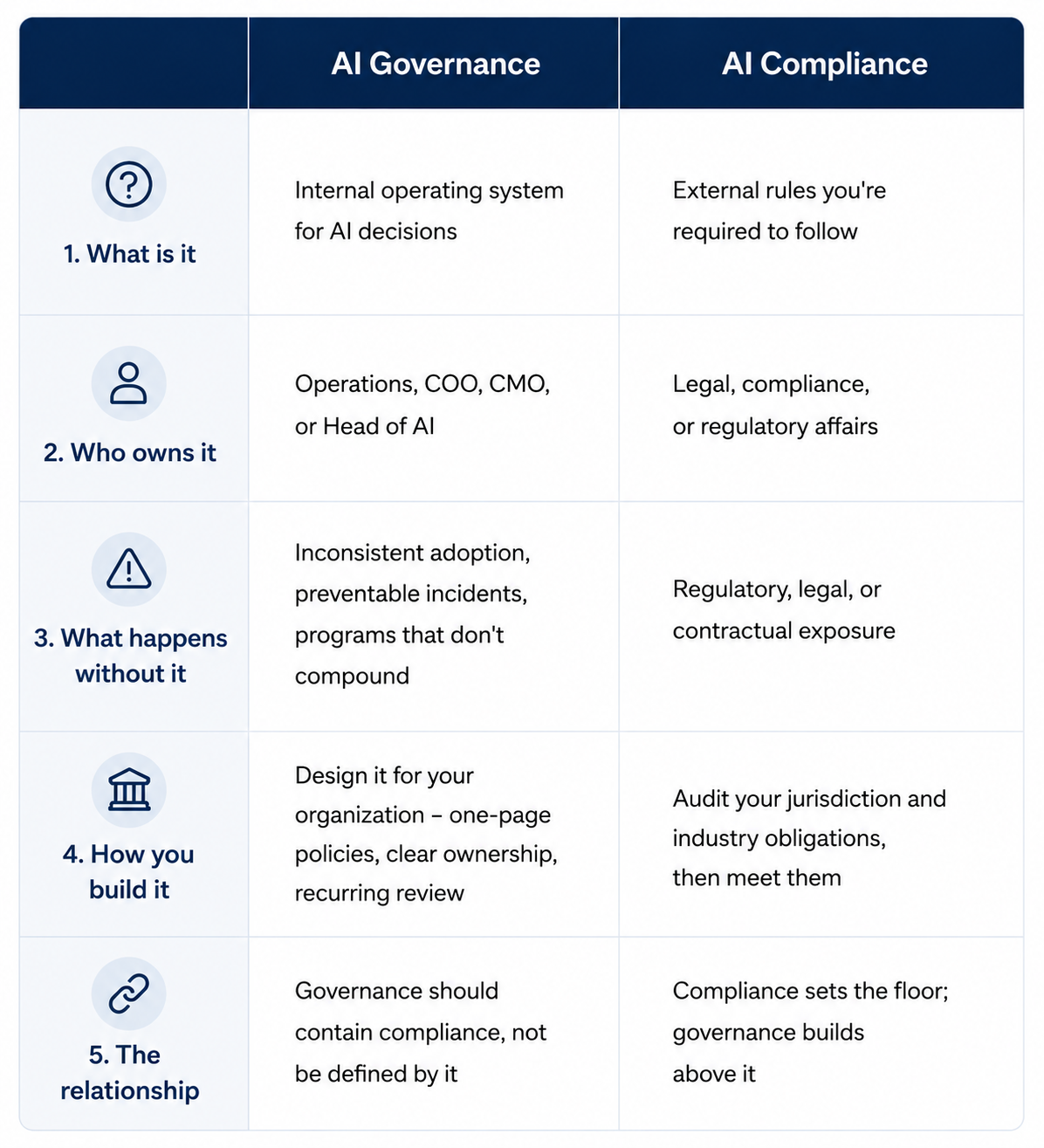
AI governance is the system your organization builds to make good decisions about AI. AI compliance is the set of external rules you're required to follow. Governance is internal and proactive. Compliance is external and reactive. You need both, but they're not the same thing - and confusing them is one of the most common reasons mid-market AI programs stall before they start.
Here's the practical breakdown.
Why the Confusion Happens
When many organizations hear "AI governance" they hear "AI compliance". They picture legal reviews, regulatory checklists, and 40-page policy documents that nobody reads. So they hand it to legal, wait for a framework to arrive, and in the meantime, nothing moves.
That's a mistake. Compliance answers the question: what are we required to do? Governance answers a different question: how do we make decisions well? The first is about meeting a minimum bar. The second is about building an organization that uses AI consistently, responsibly, and in a way that compounds over time.
Waiting for compliance to define your governance is like waiting for the speed limit to tell you how to drive.
What AI Compliance Covers
Compliance is jurisdiction and industry-specific. Depending on where you operate and what you do, it may include:
Regulatory frameworks: Canada's AIDA (Artificial Intelligence and Data Act), the EU AI Act, US sector-specific regulations in healthcare (HIPAA), finance (OSFI guidance), and education. If your organization operates in a regulated industry or serves regulated clients, you almost certainly have AI-specific compliance obligations already in effect or coming.
Data privacy law: PIPEDA in Canada, GDPR in the EU, CCPA in California. These existed before AI but apply directly to how AI tools handle personal data. If an employee pastes customer data into a consumer AI product without an enterprise data agreement, that is compliance exposure.
Contractual obligations: Many enterprise contracts now include AI use restrictions. If your client agreements prohibit using AI to process their data, that's a compliance constraint, not a policy choice.
The key characteristic of compliance: it's non-negotiable. You meet it or you don't. The consequences for not meeting it are external - regulatory, legal, contractual.
What AI Governance Covers
Governance is the internal operating system that determines how your organization uses AI - inside the compliance boundaries and beyond them.
A governance framework covers:
What's permitted and what isn't. As a clear, usable guide that employees can consult. What data can go into AI tools? What's off-limits? What's in the grey zone and who makes the call? This is Fence 1 of the Three Fences Model - a one-page data handling guide, not a compliance annex. (Read more on how to set it up here: How to Build an AI Governance Framework That Enables Speed, Not Bureaucracy)
How outputs get reviewed. Who checks AI-generated content before it reaches a client, a customer, or a decision-maker? What's the escalation path when something looks wrong? Governance defines the quality control layer between AI activity and business outcomes. This is Fence 2.
Who gets trained and how. Which employees have access to which tools? How does capability get distributed across the organization rather than concentrating in two people on the marketing team? Governance makes AI adoption intentional rather than accidental. This is Fence 3.
How the system gets updated. Tools change. Regulations change. The organization's use of AI changes. A governance framework without a review cadence becomes outdated fast. Good governance includes a named owner and a defined schedule for revisiting it - quarterly at minimum.
The key characteristic of governance: it's a choice. You design it to fit your organization, your risk tolerance, and your operating model. The consequences for poor governance are internal - inconsistent adoption, preventable incidents, AI programs that don't compound.
Where Do Compliance and Governance Overlap?
The overlap is real and worth understanding. Good governance often exceeds compliance requirements - because compliance sets a floor, not a ceiling. An organization that has done serious governance work on data handling is usually well inside its compliance obligations on AI, almost as a byproduct.
The reverse isn't true. An organization that has checked all its compliance boxes hasn't necessarily built governance. It has met the minimum. It hasn't built the internal operating system that makes AI work consistently over time.
Think of it this way: compliance keeps you out of trouble. Governance is what makes AI worth having.
A Common Mid-Market Pattern to Avoid
The pattern: a mid-market company's legal team is asked to "handle AI governance". Legal produces a compliance review and a use policy. The policy is thorough, legally sound, and 12 pages long. It gets sent to all employees. Nobody reads it. Six months later, employees are still using the same mix of approved and unapproved tools they were before, because nobody built the governance layer that translates the policy into day-to-day behavior.
The problem isn't your legal team. The problem is that governance was treated as a compliance deliverable instead of an operational one.
Governance needs an operational owner - typically the COO, CMO, or a designated head of AI - not just a legal sign-off. (Read more here: How CEOs and CMOs Should Lead AI Change Management)
It needs to be designed for the people using it, not the people auditing it. And it needs to live in the daily workflow, not in a shared drive nobody visits.
The Short Version
If you're not sure where your organization's governance gaps are, the NorthLight AI Audit Scorecard covers data handling, output review, and training coverage - the three areas where governance tends to break down first. Get the AI Readiness Audit here.
