
How to Stop AI From Replacing your Team (And Use It to Grow Instead)
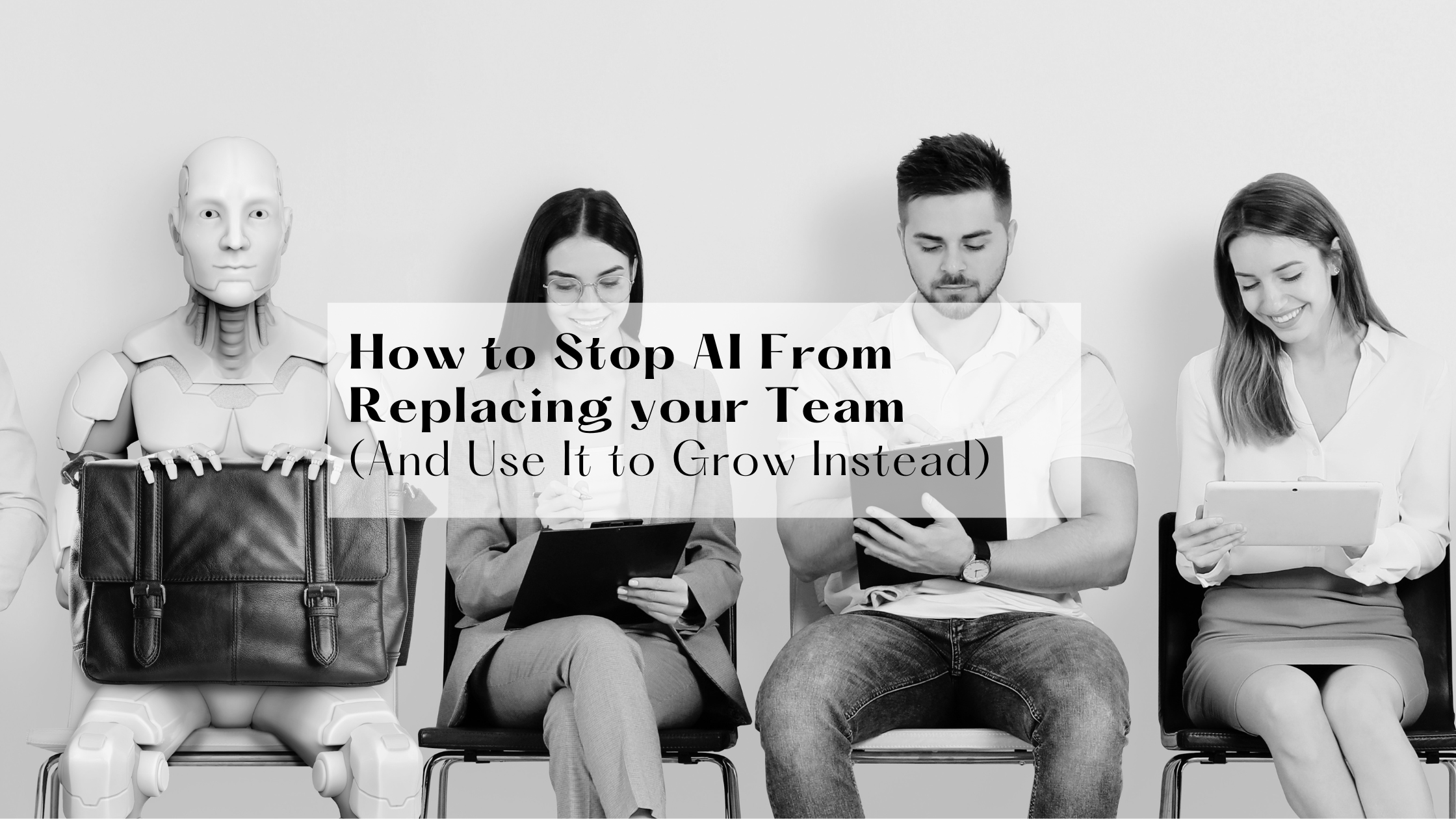
The fear that AI will replace your team is real. It's also, in most mid-market organizations, the wrong thing to be afraid of. The more immediate risk isn't that AI eliminates jobs. It's that AI gets adopted badly - and the people who were supposed to benefit from it burn out, check out, or quietly go back to doing things the old way. Used well, AI changes what teams are capable of. The difference sits in the decision about what to do with the capacity AI creates.
The Question Nobody Asks Out Loud

When a company announces an AI initiative, the question running through every employee's head is some version of: "Is this about making me more effective, or is this about figuring out how many of us they can cut?"
Most leadership teams don't answer that question directly. They talk about efficiency and productivity and staying competitive. Which, to an employee, sounds a lot like confirmation.
People who are worried about their jobs don't experiment with new tools. They perform competence - they show up to the training, say the right things, and then go back to their desks and do exactly what they were doing before. Adoption stalls. The AI program gets blamed.
If you want AI to grow your team's capability instead of threatening it, the conversation has to start honestly.
What "AI Replacing Jobs" Looks Like
In most mid-market organizations, AI displaces the repetitive, low-judgment parts of knowledge work. First drafts. Data summarization. Meeting notes. Research compilation. Formatting. Initial outreach. The work that fills hours but doesn't require the thing that makes your people valuable - their judgment, relationships, context, and institutional knowledge.
That displacement is real. A task that took three hours can take 30 minutes. And that gap creates a choice.
If leadership's answer to that gap is "great, we can do this with fewer people", the best employees - the ones with options - will notice and start looking. The ones who stay will learn to work slowly enough that nobody notices the gap.
If leadership's answer is "great, let's redirect those hours into the work we never had time for" something different happens. Teams start doing more of the high-value work that was always getting pushed aside. Client relationships get more attention. Strategic projects get resourced. People get better at their jobs, not just faster at their tasks.
The capacity AI creates doesn't compound on its own. It has to be deliberately redirected. (Read more: How to Prove AI ROI to Your Leadership Team (Before They Cut the Budget))
Three Things That Determine Whether AI Grows or Shrinks your Team

1. Whether leadership names the intent explicitly
"We are building AI capability so this team can do more of the work that matters, not so we can do the same work with fewer people."
Say it directly. Put it in the kickoff. Put it in the all-hands. Repeat it when someone asks. The alternative - letting the intent stay ambiguous - doesn't feel neutral to employees. It feels like a yes.
This doesn't mean promising no change will ever happen anywhere. It means being honest about what the current initiative is for.
2. Whether the people doing the work are involved in building the workflows
The fastest way to signal that AI is a cost-cutting exercise is to have a small team build the AI workflows and roll them out to everyone else. The fastest way to signal the opposite is to involve the people doing the work in figuring out how AI should help them do it.
When a sales rep helps design the AI-assisted proposal workflow, they own it instead of feeling replaced by it. That's the difference between adoption and resistance, and it costs nothing extra to get right.
3. Whether time saved has a named destination
Time saved without a reinvestment plan gets absorbed. More meetings. More tasks added to the pile. More Slack. Employees who saved three hours a week and just got three more hours of work assigned learn one thing from that: don't save time visibly.
The reinvestment has to be specific and it has to be named by leadership, not left to individuals to figure out.
"The time we save on first drafts goes into client strategy."
"The time we save on research goes into business development."
When people know where the hours are going, AI stops feeling like a productivity extraction machine and starts feeling like a deal that's actually fair. (Read this for deeper learning: What AI Transformation Actually Looks Like for a $100M-$1B Company)
The Growth Version of This Story

Here's what it looks like when AI grows a team instead of threatening it.
A marketing team that used to spend half its time on first drafts, formatting, and repurposing content now spends that time on strategy, client relationships, and campaigns that were always on the "someday" list. Output volume goes up. Output quality goes up. The team feels like they're finally doing the job they were hired to do.
A sales team that used to spend hours on research, meeting prep, and follow-up emails now walks into every conversation better prepared and follows up faster. Win rate improves. Pipeline expands. No one got replaced. The same people are just operating closer to their zone of genius.
A leadership team that used to wait two weeks for a market summary or a competitive analysis now gets it in two days. Decisions get made faster. Projects that used to stall because nobody had time to do the groundwork actually move.
None of that requires headcount cuts. It requires the decision to redirect the capacity AI creates rather than just extract it.
What to Do If Your Team Is Already Worried

If you're past the early stages and you can feel the resistance - people going through the motions, AI tools sitting unused, adoption numbers that look fine on a dashboard but don't show up in any actual output - here's what usually helps.
Ask directly. (In a small group, not a survey.) "What do you think this is actually for?" The answers will tell you what assumption is blocking adoption, and it's almost always some version of the replacement fear. You can't address it until you name it.
Find the person who's genuinely excited about AI and make them visible. Every team has one. The person who's already figured out three workflows that saved them hours and is quietly annoyed that nobody else is doing it yet. Put them in front of their peers. Peer credibility moves adoption faster than any top-down communication.
Change what you measure. If the only AI metric is time saved, you've told the organization that the point of AI is efficiency extraction. Add a metric that's about output quality or new work enabled. What got done this quarter that wouldn't have happened without AI? That question reframes the whole conversation.
The Short Version
AI replaces tasks, not people - when leadership makes a deliberate choice about what to do with the capacity it creates. The organizations where teams grow with AI share three things: they're honest about intent from the start, they involve employees in building the workflows, and they name where the saved time goes before it gets absorbed.
The fear doesn't go away on its own. It goes away when people can see, specifically, that AI made their work better rather than their position less secure.
If you want to know where your organization is on this - which functions are ready to grow with AI and which are still in resistance mode - the NorthLight AI Readiness Audit gives you a structured picture in about 10 minutes. Run the audit now.
