
Your Employees Think AI Is Studying Them to Replace Them. Here's What Our Research Found.
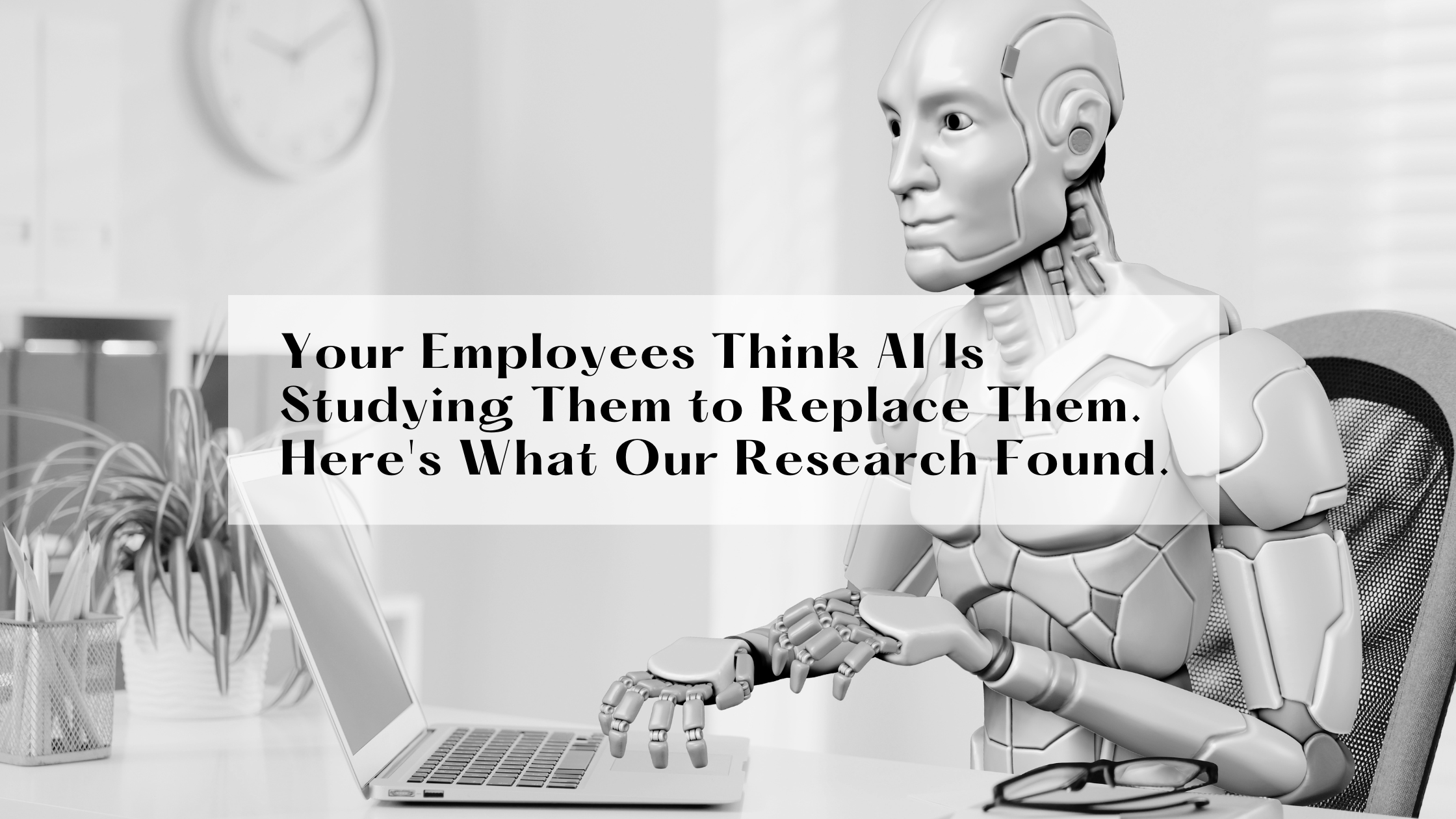
Earlier this year, my team and I set out to understand why AI pilots at mid-market companies were stalling. We talked to leaders directly and ran deep research into the patterns showing up across organizations. One finding kept surfacing more than any other: employees believe that every time they use an AI tool, it's quietly learning enough about their job to eventually replace them.I don't think leadership fully grasps how heavy this fear actually is.

The Silent Fear
Imagine going into work every day and using a tool you've been told will make you more productive, only to privately believe that tool is studying you so it can take your job. Not eventually, in some abstract future. Actively. Right now. Every prompt you type is one more data point in your own replacement.
That's the actual emotional reality our research surfaced, repeatedly, across the leaders and teams we spoke with. And when I raised this on a recent episode of my podcast with Grace Gravestock, a change management leader with over 20 years running large-scale technology projects, she didn't dismiss it either. Her read: some of what people fear is realistic. AI probably will replace a lot of repetitive, lower-judgment work. The question is what happens to the people doing it now.
I think most leadership teams respond to this fear the way you'd respond to a smoke alarm you didn't want to deal with: they mute it. "That's not going to happen" gets said in an all-hands, once, and then the topic doesn't come up again. Meanwhile the fear doesn't go anywhere. It just goes quiet, and quiet fear is exactly what produces the AI adoption stall so many companies are living through right now.

Why Silence Is the Worst Response
Here's what I've come to believe after looking at this research alongside the pattern I see in almost every AI engagement I run: silence reads as confirmation.
When leadership doesn't address the replacement fear directly, employees don't conclude that the fear was unfounded. They conclude that leadership either doesn't know the answer or doesn't want to say it out loud. Both interpretations are worse than an honest, uncomfortable conversation.
I've watched this play out inside the Northlight AI Flywheel work I do with clients. The audit stage almost always turns up the same thing: two or three people quietly doing excellent, sophisticated work with AI, and they've told no one, because the last thing they want is for their efficiency to become the evidence that justifies headcount cuts. That's a trust gap, and no amount of role-specific training closes a trust gap that's never been named.
What Actually Needs to Be Said
I don't think the answer is false reassurance. "AI will never replace anyone here" is a promise most leaders can't actually keep, and employees are smart enough to know it. The research backs this up: vague reassurance doesn't reduce the fear, it just tells people leadership isn't being straight with them.
What I think actually works is closer to what Grace described from her own change management work: name what's true, and be specific about what changes for the people in the room. AI will take over the repetitive parts of most jobs. The people who keep growing are the ones who move toward orchestrating that work rather than doing it by hand. That's a harder message to deliver than blanket reassurance, but it's the one that actually earns trust, because it doesn't ask anyone to believe something obviously untrue.
This is also where the reinvestment conversation matters more than most leadership teams realize. If AI frees up time and nobody says where that time is supposed to go, employees fill in the blank themselves, and the blank they fill in is almost always the scariest possible interpretation. (Further reading: How to Stop AI From Replacing your Team (And Use It to Grow Instead) Naming the destination for that capacity, more strategic work, more client time, more of the parts of the job people actually wanted to do, is the difference between AI feeling like a threat and AI feeling like relief.
Where This Fits Into a Real AI Program
This is why the audit stage of the AI Flywheel isn't just a technical exercise. Part of what a good audit surfaces is exactly this: who's using AI and hiding it, who's avoiding it out of fear, and what the organization's leadership has and hasn't said out loud about what AI means for people's jobs. (Read this for deeper learning: What Is the Difference Between an AI Pilot and a Full AI Transformation?)
Governance work matters here too, in a way that's easy to miss. ((Read more on how to set up the Three Fences Model here: How to Build an AI Governance Framework That Enables Speed, Not Bureaucracy) The Three Fences model isn't only about data handling and output review. Fence 3, access and training, is where an organization decides who gets to build AI skill and how that opportunity gets distributed. Distributing that opportunity broadly, rather than letting it concentrate quietly in two or three people who are afraid to raise their hands, is itself a form of addressing the fear. It says: this is for everyone, not a tool being used to sort who stays and who doesn't.

The Short Version
The fear that AI is training your replacement is a rational response to silence. Our research this year confirmed it's widespread, and dismissing it outright does more damage than saying nothing at all.
What works instead: name what's actually changing, be honest that some tasks will shift, and be specific about where the capacity AI creates is supposed to go. Do that, and the fear stops driving people to hide their AI use. Skip it, and no amount of training will get you the adoption you're looking for.
You can hear more of this conversation, including Grace Gravestock's take on why leadership visibility determines whether change projects succeed or fail, on episode 275 of AI Literacy for Entrepreneurs. If you want to see where your organization's AI adoption is actually stuck, the buy-in stage, the training stage, or somewhere else, the NorthLight AI Readiness Audit gives you a structured picture in about 15 minutes. Run the audit now.
