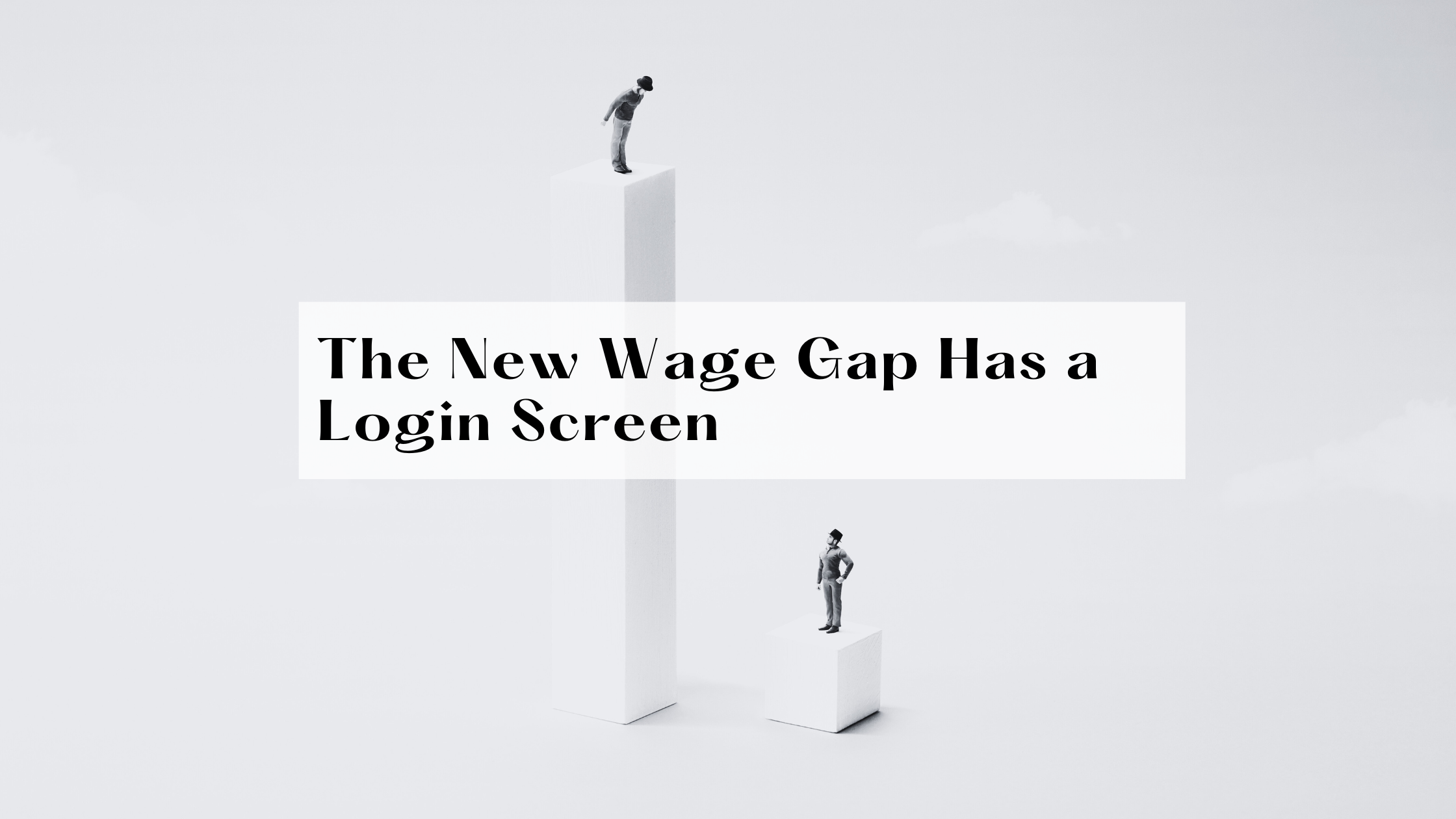
The New Wage Gap Has a Login Screen
A few years ago, I walked into a boardroom to lead a strategy session and was asked to fix the projector.
Brown woman.
Tech thing broken.
Obviously, I was IT support.
It wasn’t the first time. It wasn’t even the tenth, unfortunately. At some point, I’d started unconsciously avoiding anything that looked too techie in professional settings. If I hung back from the geeky stuff, maybe people would see me as a strategist instead of the help desk.
Then generative AI showed up. And I had a choice: stay safely in my lane, or swan dive backwards off a cliff into something that was clearly going to reshape everything.
I have a teenager. I don’t want to be in a place where nothing changes. I don’t want to be the one who sits down and says, let someone else who speaks louder speak.
So I jumped.
The Stat Nobody Wants to Unpack
Women are adopting AI at 25% lower rates than men.
When I first heard that, my gut reaction was: That’s another version of the wage gap.
Same systemic pattern. Different wrapper.
Think about it. The wage gap didn’t happen because women were bad at their jobs. It happened because of a thousand invisible forces: who got promoted, who got mentored, who got the stretch assignment, who got interrupted in meetings, who got the office with a door versus the desk by the bathroom, who got punished for having a child…
The AI literacy gap is the same story with a login screen.
The 11pm Workforce
In a recent conversation with Heather Cannings, who runs StrikeUp Canada - a digital conference that draws thousands of women entrepreneurs - she dropped something that hit me in the chest.
“We see how people join our webinars,” she said. “They’re on mobile. They’re in their cars. They’re eating lunch in a storage room at the back of their business.”
When her team asked women entrepreneurs how and when they’re actually learning AI, the answer was brutal: 10pm, 11pm, after the kids are in bed, trying to push one more thing across the finish line.
Women aren’t avoiding AI because they’re disinterested. They’re learning it in stolen moments - exhausted, alone, with no strategic support - while men get structured upskilling during work hours.
That’s an access gap dressed up as a competency problem.
The Imposter Question Men Don’t Ask
There’s another layer here that doesn’t get talked about enough. “Am I an imposter if I’m using AI?”
Heather and I both see this in the women we work with. The question behind the question: If AI helps me do this faster, does my work still count? Do I still count?
I rarely hear men wrestling with this. They just use the tool.
Women, meanwhile, are worried about being judged for using it incorrectly. Worried about getting in trouble. Worried about being seen as cheating. So they look for practical uses they feel they won’t get in trouble for - which means they stay small, stay safe, and stay behind.
This is a rational response to decades of being held to different standards. But rational or not, it’ll compound into a crisis.
The Jobs That Disappear First
When analysts list the roles most likely to be automated by AI, they point to administrative work, data entry, customer service, research assistants, creative support, writing.
Now look at who holds those jobs.
Women.
Disproportionately, overwhelmingly, women.
So the same group that’s adopting AI more slowly - because they’re exhausted, undertrained, worried about judgment, and expected to upskill on their own time - is also the group most likely to have their roles restructured or eliminated by AI.
This conversation has officially left prediction territory and moved into math.
And if we don’t change the equation, AI will blow the wage gap wide open.
The Person Who Says Nothing in Meetings
Here’s what I’ve started noticing in every AI-related conversation inside organizations.
There are the enthusiasts - usually confident, usually already experimenting, usually talking loudly about the tools they’ve tried.
There are the skeptics - bringing up hallucinations, job losses, that lawyer who submitted fake case law.
And then there’s a third group. The biggest group.
The people who say nothing.
They’re not bought into either extreme. They’re not sure if it’s safe to admit they don’t understand. They don’t know if their experimentation counts as innovation or as a fireable offense.
The silent group is disproportionately women, people of colour, introverts, and people without proximity to power.
The Real Question
Obviously, women are excellent at learning AI! Shona Boyd, a product manager I spoke with recently, taught herself AI by solving a real problem at work - then realized there weren’t many women who looked like her leading these conversations. So she started showing up publicly, being visible, being approachable. Being the reference point for people who felt afraid to ask questions. Even though it involved taking herself out of her comfort zone.
That’s the blueprint.
The real question isn’t why aren’t women adopting AI faster?
It’s what systems are we building that assume infinite time, unlimited access, and zero fear of judgment?
Because those systems don’t serve women. They don’t serve caregivers. They don’t serve anyone who’s already carrying an invisible load.
What Actually Helps
If you’re a leader reading this and wondering what to do, here’s a start: Stop designing for people who don’t exist. The ones with four free hours in the middle of a Tuesday don’t need your help. Design for the woman watching your training on her phone in a storage room during her lunch break.
Make it workshop-able, not lecture-able. One-hour AI overviews create to-do lists that feel impossible. Small-group sessions where people can actually build something? That sticks.

Stop treating AI training as spare-time homework. It runs through everything. Like the internet - but it will take a minute to get there. If it matters to the organization, it gets resourced like it matters. That means time during work hours. That means compensation. That means not asking your most overburdened people to do one more thing on their own.
I’ve called my book Swan Dive Backwards because that’s what I did. Full commitment. Enthusiastic amount of theater. Zero plan for climbing back up.
But here’s what I’ve learned - a true swan dive backwards isn’t about how brave you were.
It’s about building the bridge so nobody else has to jump blind.
I don’t want to be the only brown woman in the room talking about AI anymore. I don’t want women learning this at 11pm in stolen moments. I don’t want the literacy gap to become a leverage gap to become yet another generation of unrealized potential.
The cliff is here. The water’s cold. But nobody has to jump alone.