
AI won’t Fix your Sales
For many mid-market organizations, scale is the dream!
You get traction, then the work multiplies. More leads. More follow-ups. More handoffs. More “can you just…” requests. And suddenly your sales process becomes less like a pipeline and more like a game of whack-a-mole.
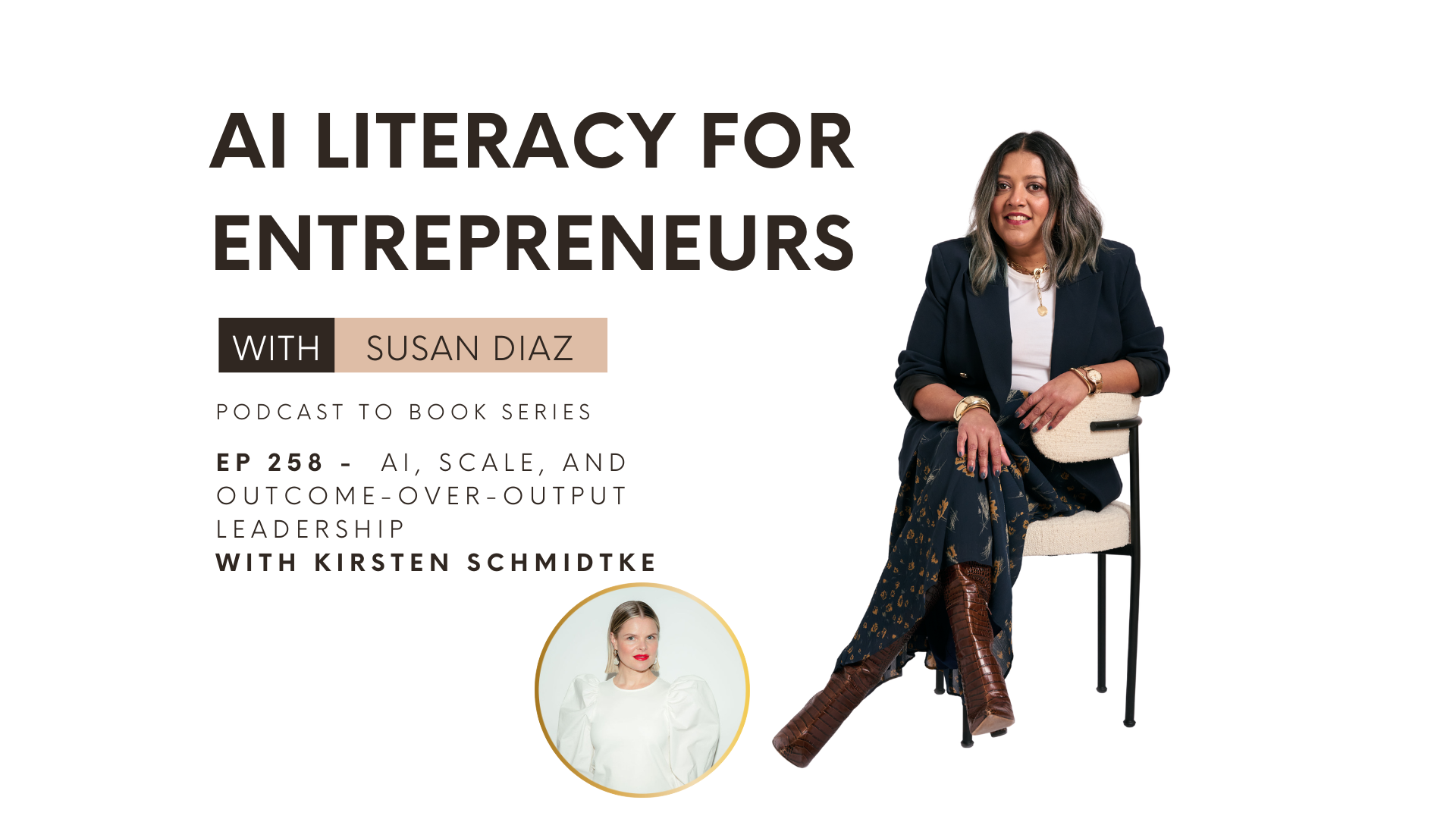
That’s what I dug into with Kirsten Schmidtke, of Kirsten Schmidtke Coaching and Consulting, in Episode 258 of ‘AI Literacy for Entrepreneurs’. (This was part of my 30 day podcast-to-book sprint that I took on in December of 2025)
AI doesn’t magically make your team better at sales. It makes you more you - faster. And that can be either a gift or a disaster, depending on what you’ve built underneath.
AI doesn’t replace selling. It replaces the drag.
For many of us, sales involves friction. The context switching friction, for example. The “where did that info live again?” friction. The “I know I should follow up but I can’t look at one more email today” friction.

AI is extremely good at reducing that drag.
It can take messy notes and turn them into a clean recap. It can help you prepare for a call with sharper questions. It can summarize a thread and pull out next steps. It can draft a follow-up that doesn’t sound like a robot - if you give it enough context.
The real shift is less about productivity and more about consistency. Because that's the problem that many teams have. Perhaps the best sellers carry the process in their heads. AI can help turn the best of what’s already working into something teachable. That’s where scale starts.
Scale is not more output. It’s better systems.
One of the themes Kirsten and I circled was this: scaling sales isn’t about sending more messages. It’s about building a system that produces good judgement more reliably.
That means you can’t start with tools.
You start with the work.
If you want AI to support sales, you need to know what you’re actually asking it to do. Here’s a simple way to frame it:
The Sales Scale Stack
Clarity: Who do we sell to, and why do they buy?
Process: What happens from first touch to closed-won?
Assets: What do reps reuse (proof, stories, objections, follow-ups)?
Data: Where is the truth stored, and is it clean enough to trust?
Coaching: How do we improve judgement, not just activity?
AI can support every layer. But it can’t substitute for a lack of sales process.
If your messaging is vague, AI will generate vagueness faster. If your ICP is blurry, AI will help you target the wrong people at speed. If your CRM is chaos, AI will confidently summarize chaos.

It’s not that AI doesn’t work.
It’s that AI is a mirror with a turbocharger attached.
The new sales advantage is context.
Sales teams who win with AI are building context. They’re creating libraries of:
customer language
objections and responses
proof points and mini case studies
deal notes that are actually usable
the “why we win” patterns that never make it into a slide deck
And then they use AI like a co-pilot, not a replacement. AI becomes the assistant that keeps your standards high on the days you’re tired. It helps a good rep become more consistent. It helps a new rep ramp faster. It helps leaders spot patterns across conversations without living inside call recordings.
But the most important part is still human.
Trust. Timing. Listening. The ability to ask one brave question and then shut up.
AI can help you prepare for that moment.
It cannot have that moment for you.
If you’re trying to scale sales right now, don’t start by asking, “What AI tool should we buy?”
Start by asking, “Where do we lose momentum?”
Then pick one friction point and design a small AI-supported workflow that makes it easier to do the right thing consistently.
You don’t need to be louder.
You don’t need to be spammy.
Just smarter - because the system finally supports the humans inside it.
If you’d like to listen to the full episode, find it here.
If you’d like to get on the list for an early copy of my book, Swan Dive Backwards, drop me a line on email or Linkedin and add you to the list.
