
Your AI Champions Are Running an Unpaid Second Job

To build an AI champions program that lasts, treat the champion role as a real job: a written scope, protected hours, an end date, work taken off their plate, and recognition in goals, reviews, and pay. Skip those, and naming someone an AI champion hands your most willing people a second job with no pay attached.
At the forward-thinking companies that jumped early into putting AI in the business, new labels showed up fast. Champion. AI lead. The people who got them already had packed calendars. The title came with a kickoff call and a chat channel, and then the real work arrived: upskilling everyone else. Call it what it is, that is an unpaid job.
What the AI champion role actually costs
A champion still does their day job. On top of it they answer questions, run demos, sit beside a colleague who is stuck and rework prompts that almost worked. None of that is on a calendar. All of it depends on goodwill.
Naming someone a champion without removing work, setting scope or recognizing the work turns a good idea into an extractive method. You take the enthusiasm of your most capable people and spend it. They will keep going for a while because they believe in the work. Goodwill is not a budget line, though, and it runs out eventually.
Some days this looks bleak to me. I wonder whether anything changes in the corporate workd. When I put that to Sira Laurel, an executive coach who works on cognitive load and nervous system capacity, she gave me a more patient read. (Sira was recently a guest on my podcast, AI Literacy for Entrepreneurs)
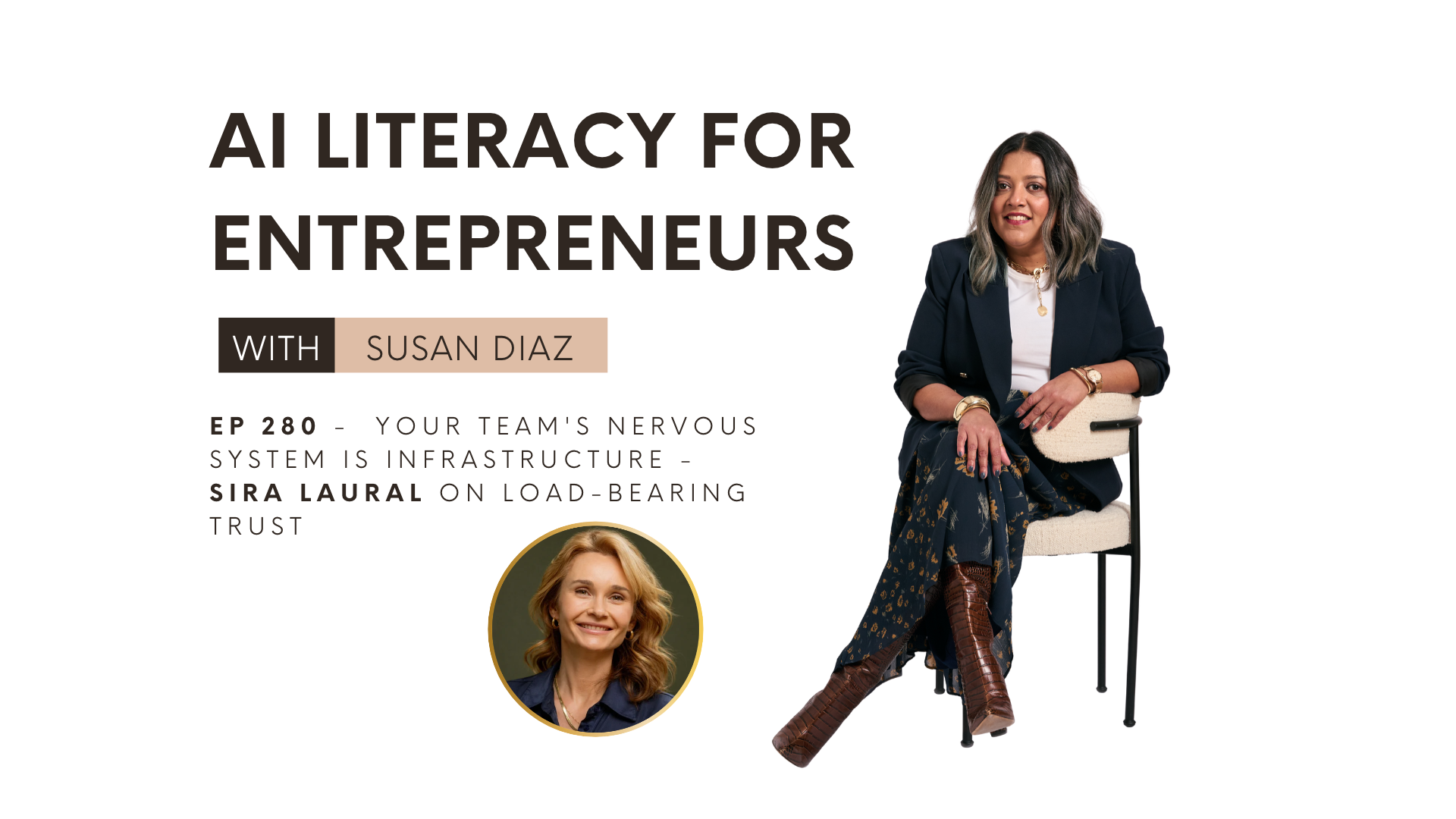
Change often feels like going backwards at first, Sira said, because of the energy it consumes and the failures along the way. Anyone who has started a new habit knows the feeling of working hard and seeing nothing yet. I take that point. It still leaves a leader with a choice: let that early stretch of effort land on a handful of exhausted people, or plan for it.
Why champion capacity decides whether adoption sticks
In the AI Flywheel, the Training stage depends on people who have the capacity to teach. If your champions are underwater, training becomes patchy, and the whole cycle slows down behind it.
It also bears on what I call the Individual Choice problem. Every employee decides, quietly and daily, whether to use the tool or go back to the old way. I dug into that in why AI adoption fails at the individual level.
Sira treats cognitive and nervous system capacity as infrastructure inside an organization. In her view, trust, safety, clarity and coherence are performance infrastructure, and they carry load even though they never show up on a spreadsheet. Her analogy fits the champion problem well. You would not run new software without checking whether the hardware can support it, and leaders need to "check capacity before adding speed, and not after a crash". She also points out that burnout and absenteeism have many small moments upstream, and a small pause at those moments saves a lot of time, money, and energy later. Your champions are that hardware.
How to build an AI champions program: six moves
These are my recommendations. They come from how I think the role should be designed, and they are not findings about any particular company.
1. Make it a job with scope, hours and an end date
Write the role down. State what the champion will do, how many hours a week the company protects for it, and when the assignment ends or gets reviewed. An open-ended title becomes permanent overtime. A defined term lets someone say yes without signing away their year.
2. Take something off their plate before adding this
Before you add champion duties, remove something of equal weight: a recurring report, a standing meeting, a project handed to someone else. If nothing comes off, the work lands on evenings and weekends, and you will not see it until the person burns out or leaves. Sira's point about messages applies here. What people believe about rest is set by what leaders do, including taking the time off they need. If leaders praise balance while piling champion work on top of full jobs, people believe the piling.
3. Define what a champion does and doesn't own
A champion teaches and shows. They run demos, share working examples and coach colleagues through their first real use case. Help desk duty belongs to a named support channel with its own owner, and policy questions belong to your governance group. Getting that split right takes leadership, HR and IT aligned before the champion role is announced. Each group owns a piece of it. The same applies to resistance. Champions should have a plan for responding to AI skeptics, and leadership should carry the harder conversations so a peer is not left to referee the team.
4. Recognize and reward it in goals, reviews and compensation
If champion work does not appear in the person's goals, it does not exist at review time. Add it to their objectives. Count it in the review. Let it move compensation or promotion decisions. HR holds most of those levers, which is one more reason they belong in the design from day one.
Recognition also protects your wider adoption effort. People who suspect that teaching others is making them replaceable may quietly stop teaching, a fear I cover in how to stop AI from replacing your team.
5. Make the champion's work visible to leadership
Put champion work on the leadership agenda. Ask champions to report what they taught, what they saw working and what blocked people. Name them in all-hands meetings. Visible work gets protected, and invisible work gets cut at the first busy quarter. If your executives also need proof of what the program returns, how to prove AI ROI to your leadership team lays out how to build that case.
6. Rotate or add champions so the load spreads
One champion per department is a single point of failure. Add more people, or rotate the role on a schedule so nobody carries it indefinitely. Peer learning also shares the teaching load, because champions learn from each other and stop reinventing every demo alone. The AI Power Circle is one place where that kind of peer learning can happen.
A related error, ignoring the people who are already doing this work, is one of the biggest mistakes companies make when rolling out AI. Fixing it costs far less than losing those people.
Podcast: Episode 281 with Sira Laurel
To hear the conversation on my podcast, AI Literacy for Entrepreneurs, please listen to Episode 281 titled "Your Team's Nervous System Is Infrastructure: Sira Laurel on Load-Bearing Trust".
Listen here: Episode 281 on Spotify
Who Sira Laurel is. Sira is an executive coach and facilitator. Her work covers leadership, organizational design, cognitive load, trust and nervous system capacity. She spends much of her time with leaders who look like they are winning on the outside and are exhausted on the inside.
What the episode covers:
Capacity beyond time: attention, decision making, emotional bandwidth and creative energy, and why saving someone time can still drain them.
Friction worth removing versus challenge worth preserving, and how to tell which is which before you automate anything.
Purpose, clarity and psychological safety as the foundation for a team that can take on change.
A behavioural check for psychological safety. Ask yourself when someone last disagreed with you in public. If nobody has, that tells you something.
If you enjoy the episode, follow the show, leave a rating and a review, and share it with a colleague who is carrying the champion role right now. The podcast has no sponsors and no ads, so shares, ratings and reviews are how new listeners find it.
Find out where your capacity actually stands
Before you name your next round of champions, find out who already has room and where your adoption plan leans on people who do not. The AI Readiness Audit is where we start.
If you want the longer arc of how I think about AI literacy, my book Swan Dive Backwards is the place to start.
